
If you spend four to six days a week in compression socks, heavy-duty sneakers, or lifting shoes, your feet aren’t just a part of your body—they are your primary equipment. For those of us in the marathon training cycle or the daily CrossFit grind, “foot care” usually stops at making sure we don’t have a black toenail or a localized fungal infection. We ignore the thickening layers of dead skin until they inevitably crack under the pressure of a high-mileage week. I’ve tried at least six different exfoliating foot masks and they all made my skin peel so aggressively that I had to stop running for ten days just to avoid raw blisters on my arches.
This is the fundamental struggle for the athlete. We need our calluses for protection (that hardened skin is what keeps us from getting hot spots during a 10k), but we need that skin to be supple enough not to split open. Most products on the market are designed for “pedicure-ready” feet, which often means stripping away every bit of protection we’ve spent months building up. When I came across the Milk Honey Foot Wax, I was skeptical. A peel-off wax sounds like it might be too superficial for the literal armor I’ve grown on my heels, but the promise of lactic acid and honey piqued my interest as a recovery tool rather than a total skin overhaul.
The Problem
For the active individual, foot skin is a paradox. We deal with constant friction, moisture from sweat, and the physical impact of thousands of steps. This leads to hyperkeratosis—the thickening of the skin—which is the body’s way of protecting itself. However, when this skin becomes too dry, it loses its elasticity. If you’ve ever felt a heel crack mid-squat or felt the sting of a fissure while pushing off for a sprint, you know exactly why “soft skin” isn’t just a vanity goal; it’s a performance necessity.
The issue with most retail foot peels is the downtime. Most of them use high concentrations of glycolic or salicylic acid that trigger a “shedding” phase five days later. As an athlete, you cannot have sheets of skin falling off inside your socks during a workout. It creates friction, it’s messy, and it often leaves the new skin underneath far too tender for high-impact activity. We need something that hydrates the existing callus so it stays flexible, while gently lifting the “spent” top layer of dead cells without compromising the structural integrity of our feet.
What I Looked For
When evaluating the ROZINO Milk Honey Foot Wax, I wasn’t looking for a miracle that would give me “baby feet” overnight. In fact, I don’t want baby feet; I want strong, resilient, healthy feet. My criteria were very specific to the athletic lifestyle:
- Controlled Exfoliation: I needed a product that softens the keratin (the protein that makes up calluses) without dissolving it entirely.
- Anti-Inflammatory Properties: After a long day of training, my feet are often swollen and hot. Ingredients like honey and milk proteins are known for their soothing properties.
- Zero Greasy Residue: There is nothing worse than applying a foot cream, putting on socks, and feeling like you’re sliding around inside your shoe. The product needs to absorb or peel off completely.
- Efficiency: I don’t have two hours to sit with my feet in plastic bags. A 15-to-20-minute window is the max I can spare during a post-workout recovery session.
Testing Milk Honey Foot Wax for Athletes
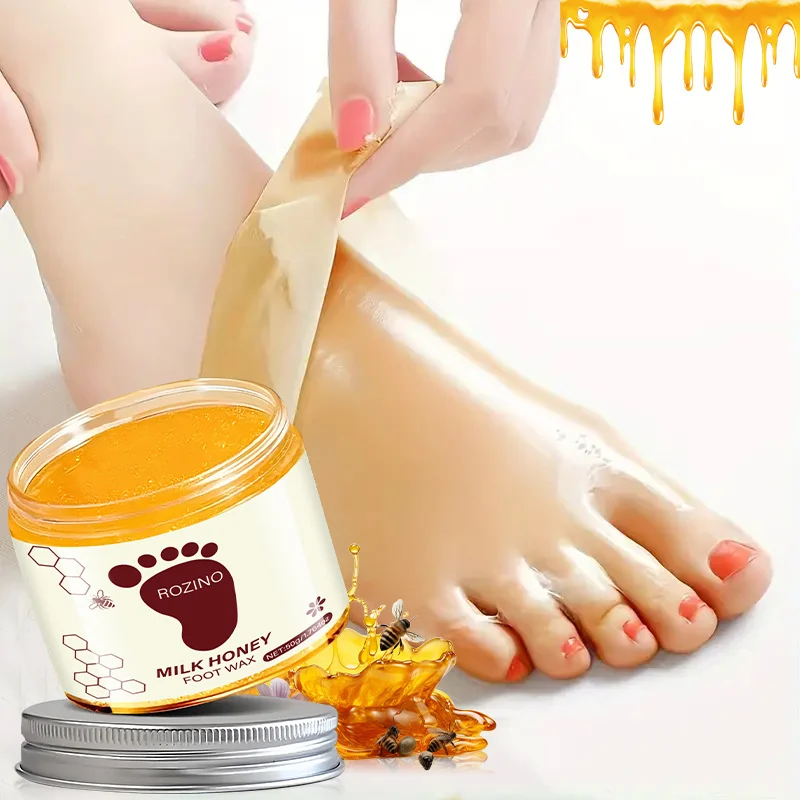
The application of this wax is different from your standard cream or “booty” mask. It has a thick, viscous texture—reminiscent of actual honey—that you spread over the sole and heels. I found that applying it with a flat silicone spatula (or even a dedicated spoon) helps get an even layer without getting it under your fingernails. The scent is mild and pleasant, not that harsh chemical smell you get with acid-based peels.
During the drying process (which took about 18 minutes in my relatively dry home gym environment), the wax starts to tighten. This “firming” sensation is actually quite nice for tired arches. It feels like a very light compression wrap. As it dries, the milk and honey are supposed to penetrate the layers of the skin. Unlike a soak, this wax creates an occlusive barrier, forcing the nutrients into the skin rather than letting them evaporate. For an athlete, this is where the coconut oil and Vitamin E really shine. These ingredients are essential for repairing the microscopic tears in the skin that occur from constant pounding on the pavement.
The peeling process is the most satisfying part, but also the most telling. With a traditional chemical peel, the skin comes off in thin, flaky bits over a week. With this wax, you peel it off in one or two large pieces once it’s dry. When I pulled the wax off my heels, I noticed that it didn’t take “live” skin with it. Instead, it lifted the grayish, dry “dust” that accumulates on the surface of calluses. My feet didn’t look like they belonged to a newborn; they looked like healthy, well-maintained athletic feet. The rough edges around my big toe—a common friction point for lateral movements—were significantly smoother to the touch.
One specific observation: I used this after a particularly grueling 12-mile trail run. Usually, the skin on my soles feels “tight” and almost brittle the next day. After using the wax, the skin remained pliable. I didn’t experience that usual post-run dryness that leads to peeling. The lactic acid in the milk is a very gentle humectant (it draws moisture in while it exfoliates), which is much better for our needs than the aggressive peeling agents found in drugstore brands.
Verdict for Athletes
If you are looking for a product that will make your feet shed like a snake so you can wear sandals to a wedding, this might be too gentle for you. However, if you are an athlete who needs to maintain foot health without interrupting your training schedule, this is a top-tier choice. It bridges the gap between a superficial lotion and a radical chemical peel.
The ROZINO Milk Honey Foot Wax is specifically effective for those who deal with “sandpaper heels” that catch on their socks. It provides enough hydration to prevent deep cracks while removing the superficial dead skin that causes discomfort. The fact that it dries into a peelable film means you aren’t left with a slippery mess, which is vital if you need to get back on your feet quickly. My only caveat is that you must ensure your feet are bone-dry before application; otherwise, the wax won’t set properly and you’ll end up washing it off instead of peeling it, which defeats the purpose of the mechanical exfoliation.
For the best results in a training block, I’d recommend using this twice a week, ideally on a rest day or after your hardest session. It’s a small investment in maintenance that can prevent the kind of skin failures that actually keep you off the track or out of the gym. It isn’t a “game-changer” in the sense that it gives you new feet, but it is a significant tool for keeping your current feet in peak performance condition.

